“What’s Next, America?” FAQ: Learn more about NIFI’s newest initiative
What is “What’s Next, America?”
“What’s Next, America?” is a nationwide initiative of the National Issues Forums Institute designed to help communities come together locally to talk, decide, and act on the issues that matter most to them as the country approaches its 250th anniversary. The initiative builds on decades of experience helping communities use deliberation to address public issues and strengthen civic life.
What is the National Issues Forums Institute?
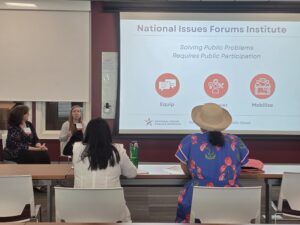
National Issues Forums Institute staff introduce attendees of the Community Engagement Administrators Conference to deliberation and “What’s Next, America?” The conference was organized by NC Campus Engagement at Elon University.
“What’s Next, America?” is developed by the National Issues Forums Institute and a broad—and growing—coalition of partners from nonprofit, educational, philanthropic, governmental, and faith-based organizations. NIFI is a nonpartisan, nonprofit organization with a mission to equip, empower, and mobilize people to use deliberation to take action for the public good. For more than 40 years, NIFI has supported communities, campuses, schools, and organizations in using deliberative practices to address complex public issues.
How does “What’s Next, America?” work?
“What’s Next, America?” invites participants to work through three sets of deliberative discussion questions centered on three overarching questions:
- Where are we now?
- Where do we want to go?
- How will we get there?
Communities typically hold a series of conversations over time, allowing participants to build understanding, identify shared priorities, and explore possible paths forward. These discussions are often followed by an action summit, where participants identify concrete next steps and sign up to work on projects with others in their community.
Rather than prescribing solutions, “What’s Next, America?” helps communities determine their own priorities and chart their own path forward.
Who can participate?
Anyone can participate! “What’s Next, America?” is designed to be flexible and adaptable for a wide range of communities and organizations, including neighborhoods, towns, schools, colleges and universities, libraries, faith communities, nonprofit organizations, and civic groups.
The initiative works best when it includes a broad range of perspectives and experiences. Organizers are encouraged to reach beyond their usual networks and invite people whose voices may not always be included in community conversations.
Why was “What’s Next, America?” created?
“What’s Next, America?” emerged from a growing desire among communities for ways to discuss issues that matter locally while also moving beyond conversation toward action.
At a time when research suggests many Americans want to work across differences but lack opportunities to do so, “What’s Next, America?” provides a framework that carries forward a long American tradition of neighbors coming together to shape the future of their communities.
What does “What’s Next, America?” have to do with America’s 250th anniversary?
As the United States approaches its 250th anniversary in 2026, many communities are reflecting on both the nation’s history and its future.
“What’s Next, America?” encourages communities to use this milestone as an opportunity not only to celebrate, but also to consider important questions about where they are today, what kind of future they want to create, and how they can work together to make progress.
The initiative focuses on local action because the future of the country is shaped by what happens in communities every day.
Is “What’s Next, America?” nonpartisan?
Yes. “What’s Next, America?” is a nonpartisan initiative and should be treated as such in local organizing efforts.
But participants are encouraged to bring their own experiences, values, and perspectives to the conversation. The goal is not to persuade people to adopt a particular position, but to help communities better understand one another, weigh tradeoffs, identify shared concerns, and work together on actions that serve the public good.
What is deliberation?
Deliberation is a key civic skill and a structured democratic practice for addressing complex issues and solving public problems. It involves considering diverse perspectives, weighing options and tradeoffs, and identifying common ground before moving to action.Deliberation helps groups move from asking, “What do we think?” to asking, “What should we do?”
How can I bring “What’s Next, America?” to my community?
Getting started is easier than many people think.
Good first steps include:
- Reviewing the free participant and planning guides
- Attending an upcoming workshop or Community of Practice meeting
- Joining drop-in hours or scheduling a call with the NIFI team
- Exploring the resources available on the website
“What’s Next, America?” can be adapted for communities of all sizes, from small groups to community-wide initiatives. It begins with establishing a diverse planning team to build local partnerships and reach out to people who may be interested in participating in conversations. For more information on planning local initiatives, check out our planning guide.
If you’re not sure where to begin, the NIFI team is happy to help you think through what might work best in your context.
What resources and training are available for “What’s Next, America?” organizers and participants?
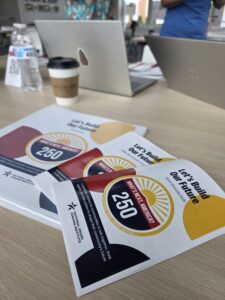
To support local “What’s Next, America?” initiatives across the country, NIFI provides free materials, trainings, and opportunities to connect and learn with a network of other people working on similar projects in their communities. This is a non-comprehensive list of some of these resources that can be found on our website.
Materials:
- Participant guides, including a standard community version and versions tailored to K-12 and college/university contexts
- One-page question sheets for the community, higher education, and youth versions of the guide
- Planning guide for organizing and facilitating conversations
- Reflection journal to track progress and request feedback
- A “Talking Points Toolkit” for “What’s Next, America?”
- A “Media and Community Outreach Toolkit” for “What’s Next, America?”
- Interactive map of “What’s Next, America?” efforts
- Website with tools, resources, and contact information for the NIFI team
Collaborative learning opportunities:
- Intro sessions: Monthly welcome calls to learn about “What’s Next, America?” and explore how it may fit your community
- Workshops: Sessions on planning, facilitation, monitoring impact, and moving from conversation to action
- Community of practice convenings: Interactive, monthly topic-based gatherings to share insights, challenges, and ideas with others doing this work
- Special topic trainings: Deep dives on emerging topics. Email Dawn at dharfmann@nifi.org with any topic suggestions!
- Team coaching sessions: Intensive, appointment-based, 1-3 hour sessions with NIFI staff and/or collaborators to support your team at any point in the WNA process. Reach out to Dawn at dharfmann@nifi.org if interested.
- Drop-in hours: Open office hours to ask questions and connect with NIFI staff
- Schedule a call: For one-on-one support, schedule a call with a NIFI team member by emailing Dawn at dharfmann@nifi.org.
What happens after a “What’s Next, America?” conversation? How do communities move from conversation to action?
A single conversation is often just the beginning.
Many communities hold multiple discussions that allow participants to better understand local challenges, identify priorities, and build relationships across different perspectives. These conversations often culminate in an action summit or planning sessions where participants identify specific next steps and commit to working together on projects that address community needs.
What kinds of projects may come out of “What’s Next, America?”
We’ve seen success with this model before. “What’s Next, America?” builds on successful state-based efforts like “What’s Next, West Virginia?” and “What’s Next, Alabama?,” that began a decade ago where communities used structured, inclusive conversations to address complex local challenges and strengthen civic life. Resulting community actions included organizing a local arts festival to help support young artists, developing after school programs for teens, and forming a county’s first Narcotics Anonymous group to address opiate addiction rates. The most successful projects are those that emerge directly from local conversations and respond to community needs and opportunities.
Who can I reach out to if I have more questions?
We’d love to hear from you.
For questions about organizing a “What’s Next, America?” initiative, trainings, workshops, or community support opportunities, contact Dawn Harfmann at dharfmann@nifi.org.
For media inquiries, storytelling opportunities, or to share your community’s “What’s Next?” experience, contact Christine Fernando at cfernando@nifi.org.
You can also explore resources, upcoming events, and contact information on the “What’s Next, America?” website.