High School Students Practice Deliberation at Detroit Student-Led Conference

At times the tensions on the national political landscape can be overwhelming – not just for adults, but also for young people soon to gain adult civic responsibilities. Yet there are relatively few opportunities for youth to learn and practice effective civic engagement in these circumstances. What if there was a proven way to support youth in developing a sense of agency and confidence that their voice matters? And what if this could be done in such a way that the young people enjoyed and valued the process – in some cases so much that they wanted to replicate it for other students?
For the last three years, an example of exactly that has been demonstrated in Detroit, Michigan with the leadership of Amy Bloom and Michael Steinback. Michael serves as Executive Director of Detroit CARES Mentoring Movement, and has a background in commercial banking, risk management, and has worked on various deliberative democracy platforms around the US and abroad. Amy is a retired social studies educator, lawyer, and Research Scholar in Deliberative Democracy at the Center for the Study of Citizenship at Wayne State University.
Since 2023 Amy and Michael have been engaging high school students in an annual student-led conference. The event brings together youth from different high schools in Wayne, Oakland and Genesee Counties to build civic and deliberative skills. The students’ backgrounds vary widely across socioeconomic level, race, ethnicity, culture, and the type of community (urban, suburban) in which they live. The idea for the conference was student-generated in a high school civic engagement class that Amy was teaching at the time. As they were discussing ways to improve education, students arrived at the idea for a student conference through their curiosity about how COVID was affecting other students’ educational experiences.
Amy and Michael joined forces with two colleagues who worked in restorative justice, and who were similarly interested in fostering student agency and voice, and the team secured a grant to fund the conference. They recruited teachers and performed much of the organizing legwork to make the conference happen. This included designing pre-conference activities to capture youth input in the conference content and activities. This preconference work, Amy said, was essential. It was important that the conference had a substantial youth leadership component and that students had input during the planning process. Many aspects of the conference, from the food, which was very important to the participants, to the overarching topics to be discussed, were selected by students.
The Conference
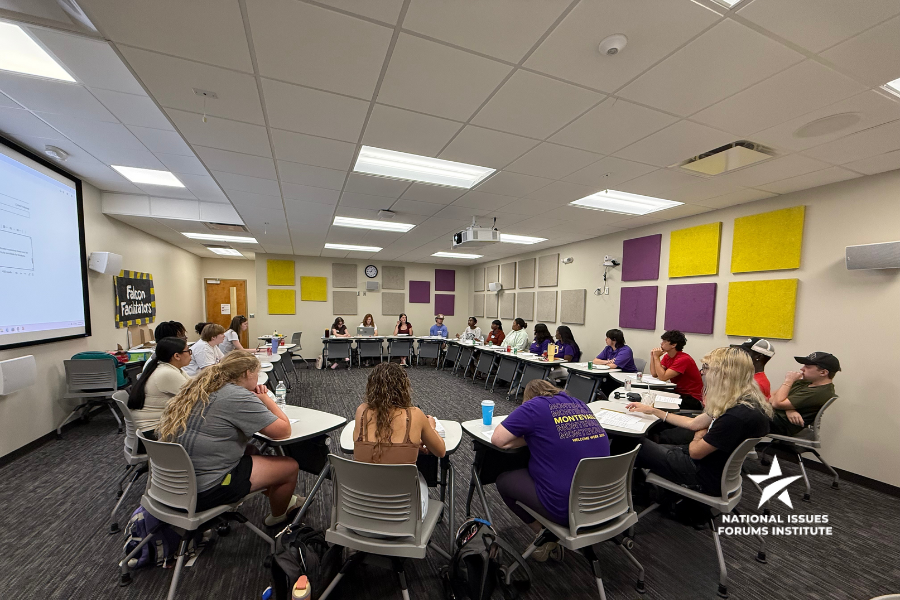
On the day of the conference that first year, students arrived at the towering entrance of Wayne State University Law School. Many were nervous – they had shared as much in their preconference surveys. Inside, after fueling up with the provided breakfast, students dove into the conference program. The day was broken into three main components, sequenced intentionally to first establish a foundation of trust and relationship that was then built upon as students discussed and deliberated on more contentious topics. After an opening plenary, all students engaged in “listening circles,” reflecting in multiple small groups on a prompt they had selected collectively ahead of time using anonymous polling software. They had chosen to discuss how students were navigating the transition back to in-person learning following remote learning during COVID. The second component of the conference included discussion of the public issues that had been collectively identified by students in the weeks and months leading up to the conference. Finally, in the third component, students engaged in the first step of a deliberative process, identifying or “naming” a problem to be considered. They worked in small groups to respond to the prompt: “We believe that one of the biggest problems in education facing us and future generations is….” Together each group identified a problem, considered ways to address it, and examined tradeoffs.
Navigating Student Leadership
The conference provided opportunities both for students to practice leadership and for adults to encourage and support it. For both students and adults this entailed some effort to, as Amy likes to put it: “become comfortable with being uncomfortable.” Not only did students help organize the conference, the breakout sessions were also student-facilitated. Students in Amy’s democracy and citizenship course underwent training to moderate these conversations. “I had students who were wallflowers moderating conversations of their peers,” she said. In one poignant moment at the conference a student moderator noticed that peers from other schools in her group seemed very anxious and afraid to participate. So she took it upon herself to make them feel more comfortable and encourage their participation.
Meanwhile, the adults at the conference were called upon, in situations like these, not to step in but to step back and allow space for students to practice peer leadership. Amy noted that it can be intimidating for adults, including teachers, to loosen the reins on students when it comes to discussing contentious issues. At one point a student moderator was unsure of how to handle a particular situation in their group. They looked to the adult in the room, who happened to be Michael. Wanting to encourage students to practice struggling through challenging moments, but with support, Michael simply gave the student moderator an encouraging nod. That was all the student needed, and they proceeded to navigate the moment just fine. This balance of student leadership and adult guidance was key. Amy said, “Our role was primarily to provide a safe and secure space” and to help establish the rules and norms, then to step back and watch what students could do.
The Spirit of Deliberation
The results were impressive. Not only did students successfully help plan and facilitate their own conference; the event had real impacts on their deliberative skills, and on measures of civic engagement and agency. Adults watched as students began to understand and embody, as Michael put it, the “spirit of deliberation,” or the practice of contemplating, considering alternative viewpoints, and proposing alternative solutions. He described how over the course of the day he observed one student, whom we will call Martin, shift from having attended the conference simply as “something to do” to being transformed. Throughout the day, Martin gradually realized his ability to use his voice and that his perspectives had just as much right to be heard as those of more outspoken members of the group, and he began to share his own thoughts with his peers.
The deliberative process had a similar effect of leveling the playing field for other students as well. Those who may have arrived at the conference with less factual knowledge about an issue that was being discussed would often contribute some of the best questions – developing empowerment and conviction that their voice mattered and stood on equal footing with those of their peers. Similar increases in a variety of measures of civic engagement were demonstrated numerically by comparing pre- and post- surveys. For example, the conference, in one day, generated a marked increase in students’ belief in the importance of voting: the number who “strongly agreed” that it was important jumped 10%. As Amy pointed out, a proportional increase in evaluation of the importance of voting among the general U.S. voting public would be truly remarkable.
The development of deliberative skills and a sense of agency and capacity to use them have impacts that extend far beyond civics, as well. Youth at the conference “learned in a roundabout way how to be,” Michael noted – how to more thoughtfully navigate interactions with friends and loved ones, and in their communities. Amy remarked on the prescience of one student’s observation: “I learn more from listening than speaking.” And part of this learning included an expanded awareness of each other’s lived experiences. For example, students at more well-resourced schools were shocked to find that their peers at less affluent schools did not have access to all the same kinds of programs they did. But even more, students across the board realized their commonalities. Michael observed, “One of the main outcomes was students realizing how alike they were. They were all dealing with the same issues, in different ways.” Or as Amy put it, they learned that, essentially, “We’re all in the same storm, just in different boats.”
A Model that Merits Replication
With these kinds of impacts, and supported by ongoing student demand, Amy and Michael have felt compelled to continue the conference each year since 2023. One of the reasons the conference works so well, they observed, is that it’s driven by the students’ (and the adults’) natural curiosities. Topics are selected by students, so they are relevant and of interest. Students’ inherent desire to better understand those topics and their peers’ perspectives on them provides real-life justification and motivation for learning and practicing deliberative skills – and an excellent hands-on example of how those same skills could be applied in other aspects of their civic and personal lives. Zooming out, the conference provides a powerful example to deliberation practitioners and educational leaders alike of the far-reaching community, civic and educational impacts of youth-led deliberation.